
LinkedIn: Is it a dying platform?


I created my LinkedIn account in November 2010. At the time I was the network manager at a secondary school, and having connections to people was useful. My LinkedIn network back then was pretty small (it still is compared to some), and it wasn't a site I visited often.
Since 2010 I've logged my career on LinkedIn, which has been helpful when going for new jobs as I've been able to see that potential employers have looked at my profile. A lot has changed in the last 16 years, and "the algorithm" is one of those things.
My usage of LinkedIn today leads me to question "is it a dying platform"?
How I used to use it
Before I ran my own company I was incredibly picky about how I used LinkedIn. I'd only connect with people that I'd worked with in some capacity (professionally or as a volunteer), or people that I knew personally. My aim was that my network would be full of people that I could vouch for, and that could vouch for me. There was also an element of "these people can help me, and don't damage my reputation" - I have rejected requests from people that I wouldn't vouch for for those reasons.
My profile tended to be locked down, to preserve privacy, unless I was looking for a new job. I'd publish job updates so that my connections could see them, but unconnected or logged out / anonymous users were limited to the headlines and no profile picture.
How I use it now
Being the only social platform my company is on (at the moment), I opened up my LinkedIn profile so it was more visible. I've got a company page to help people find my business, and I'll re-post personal posts from my company. Apparently that's the better way of doing it.
Rather than being picky in my connections, I send connection requests to potential clients and accept them fairly freely. My "network" has grown to include people I've never worked with, and barely heard of, all in the hope that I'll find some work that way. I don't like cold-calling and cold-emailing, so while I've sent some messages to "prospects" via LinkedIn, I've not pursued this heavily.
I post more than I used to on LinkedIn, finding something to write to promote my services or share a tip. I wrote a series of tips to help people protect their organisation (also available on this blog) and made some posts during 2025's cyber security month (also on here) but they didn't get many views. I'll come on to why that was in a bit.
The Feed
Sadly, as my network has grown so has my feed. It would be very easy for me to spend hours a day just scrolling and reading posts from my connections, although I wouldn't usually get something useful from what I read. I found I doomscrolled LinkedIn more on my phone than when sat at my computer, so try and minimise phone-app use.
Part of the reason I wasn't getting anything from the posts was because they all followed the same formula. Short paragraphs, really short sentences with plenty of "the thing is", "the real problem", and "what most people miss" type hooks. Over time my feed was increasingly filled with the same formatted junk that took a lot of words to say not a lot. Sometimes it was simply wrong, other times it was unbelievable. "I've never met anyone that knew burn out was coming" read one. Really? It might be true but I find that hard to believe - it was likely just a hook.
I suspect the reason for this is because a lot of posts seem to be "AI" generated slop. Research by Pangram, who provide "AI detection services", found that 41% of LinkedIn posts were AI slop. This was reported by The Register in their article of 9th July 2026, and the research matches my experience. Longer posts were found to be more likely "AI" generated, and apparently in such cases it was generally all of the post generated this way rather than a human being assisted by "AI".
Obviously it's worth pointing out that a company providing "AI detection services" would claim to find a lot of "AI" use, but in this case I think they're right.
So with my feed now containing more and more junk, and given I have a profile with only 860 connections, what do the feeds of those with many more connections look like? What benefit are they getting from the majority slop they're served?
LinkedIn Premium
I was offered a free trial of LinkedIn Premium, so I figured I'd give it a go. Premium gave me the ability to message people that weren't yet connections and also to advertise my services better. I could also receive requests from people asking for the services I offered (or perhaps they just got shown to me, as none ever seemed personalised).
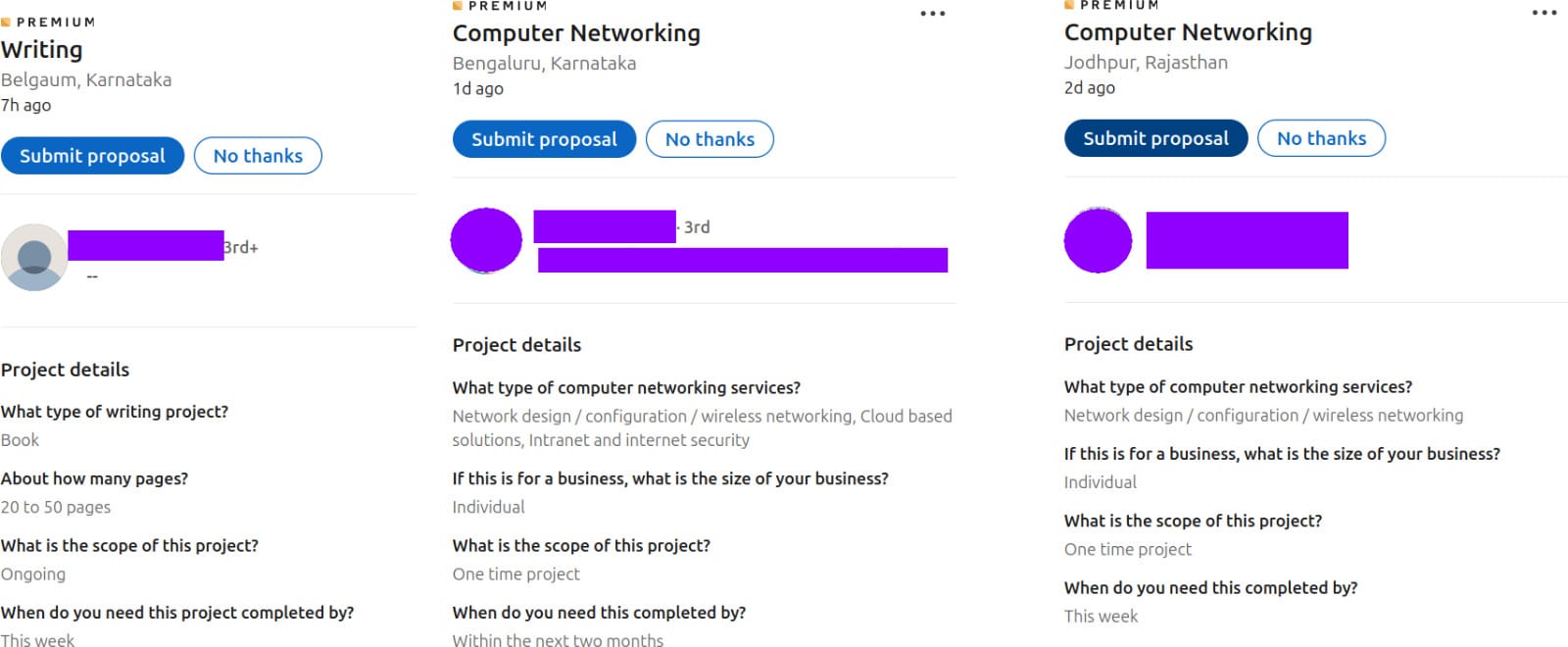
Despite setting my services to be available to the UK, I was regularly getting requests (or shown requests) for India. The level of details was always awful and typically short notice. I'll highlight that the requests I was seeing were always light on details, regardless of the country of the requester - this is just a screenshot I had to hand.
To make matters worse, I was then getting messages through the services portal where people were actually using it to spam me with details of their services. They were basically using it backwards!
Needless to say, LinkedIn Premium wasn't a cost I thought I could justify in my business.
Why I think LinkedIn is dying - The Algorithm
Desperate to find more customers, and to use LinkedIn better, I signed up for a course run by someone from my business networking group. She ran a good course that took us through what types of content there is, what works best, optimal posting times, and provided templates. I want to be very clear - her course was absolutely fine, and there was a nice community feel to the sessions.
What I found interesting, and horrifying, was the algorithm. If you've been on LinkedIn a while, you'll see people talking about how the algorithm has changed and how you should "follow these top tips to increase your reach". It's the algorithm that decides what you see in your feed, how many people see your posts, and whether or not to penalise you. Including a link to another website in your post? You'll be penalised for that.
Using post templates I found I got extended reach, with my posts viewed a lot more. My posts were formulaic, like the posts I've criticised already, and didn't follow my writing style. A friend even commented to me that something was obviously happening because the posts didn't sound like me. Not sounding like me is a problem when I work in an industry that's all about integrity and trust.
I discussed moving away from the templates with the course tutor because they weren't my style, and literally represented the types of post I hated. We agreed that I'd go "off piste" but should still follow the guidelines on optimising posts in terms of type and time of day. Very sensible, and the course was certainly useful in that regard, but my hand-crafted posts didn't do nearly as well.
So what does this tell us? I'd suggest that it demonstrates that you're no longer writing for the humans in your network, you're writing for the algorithm. The algorithm will decide if it likes your post, and whether or not it shows that more widely. With everyone writing for the algorithm there's so much noise in people's feeds that a small company like mine doesn't stand a chance of getting work this way.
(Or, of course, it shows that I don't write interesting content, but I think the amount of readers of my blog disproves that!)
Closing thoughts
LinkedIn is probably still a necessary evil for me, but the time required to stand a chance of getting work through it seems disproportionately high. I've had one piece of work come to me through LinkedIn, and that was only because a former associate had seen that I now ran my own company.
I'll keep my profile, but I can't imagine I'll be posting on LinkedIn much.
Banner image: Photo by Shutter Speed / Unsplash